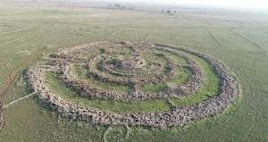

The newly discovered sites all share a similar design: large circular structures, between approximately 50 to 250 meters in diameter, built with stones taken from local basalt fields.
The stone circles of Rujm el-Hiri, nicknamed “Israel’s Stonehenge” or “Gilgal Refaim,” are not the only ones of its kind, according to a new study by Ben-Gurion University of the Negev (BGU) researchers.
By using advanced satellite imagery and remote sensing technology to survey areas previously inaccessible, BGU researchers have identified at least 28 other sites within 25 kilometers of Rujm el-Hiri that were not previously known.
The findings, recently published journal PLOS One, suggest that Rujm el-Hiri was not a singular, isolated monument, but rather an “elaborate example of a widespread architectural tradition integrated into the social and economic systems of the proto-historic Levant.”
Rujm el-Hiri was first discovered in the Golan Heights in 1968, and has been dated to approximately 3,500 and 6,500 years ago. It is made of a central cairn encircled by multiple concentric basalt stone rings, spanning for over 150 meters in diameter.
Satellite imagery revealed that the newly discovered sites share a similar design: large circular structures, between approximately 50 to 250 meters in diameter, built with stones taken from local basalt fieldstones.

Site part of a broader social, economic system
The discovered structures contain circular walls and internal partitions, often located near seasonal water sources and integrated into agricultural land use, revealing how ancient populations managed their resources and moved across the area.
Further, researchers believe the stone circles may have been multi-purpose, serving as ritual gathering places, territorial markers, or assembly sites for ancient herding communities, adding to earlier theories of Rujm el-Hiri being a burial site or astronomical observatory.
According to Dr. Michal Birkenfeld of BGU’s Department of Archaeology, the circles “invite a reinterpretation of significant proto-historic monuments in the region, recognizing them as integral parts of broader social and economic systems.”
"Our analysis may have implications for previous interpretations of Rujm el-Hiri's function," she concluded. "While traditional archaeological methods remain essential, this landscape-based perspective allows us to reach a fuller understanding of these monuments within our shared human past."
LATEST POSTS
- 1
 I’m a doctor. Here are 10 science-backed tips to help you get healthier.
 - 2Find the Lively Food Markets of South America
- 3Motivational Travel Objections for History Buffs
- 4The year's first meteor shower and supermoon clash in January skies
- 5Check out the exclusive pitch deck Valerie Health used to raise $30 million from Redpoint Ventures to automate healthcare faxes


- Hubble Space Telescope spies dusty debris from two cosmic collisions
- Protest inspired by 'Gen Z' movement draws few young people in Mexico and many government critics
- Roche breast cancer pill cuts risk of disease recurrence by 30% in trial
- As tetanus vaccination rates decline, doctors worry about rising case numbers
- Day to day Temporary Positions That Compensate Fairly in the US
- NASA unveils close-up pictures of the comet popping by from another star
- Figure out How to Utilize Your Web based Advertising Degree to Break into the Tech Business
- How to watch 'Tell Me Lies' Season 3: Episode release times, streaming info and more
- Early Thanksgiving week forecast: Where Americans can expect cold, rain and snow for the holiday