For the first time in more than 50 years, NASA is preparing to launch astronauts around the moon.
On Wednesday, the agency will attempt to send four crew members — NASA astronauts Reid Wiseman, Christina Koch and Victor Glover and Canadian astronaut Jeremy Hansen — on a 10-day journey in which they’ll first orbit Earth then circle the moon. The mission, known as Artemis II, will be the first time NASA’s Space Launch System rocket and Orion capsule carry humans into space.
If successful, the flight will be a major step toward NASA’s goal of establishing a long-term presence on the lunar surface.
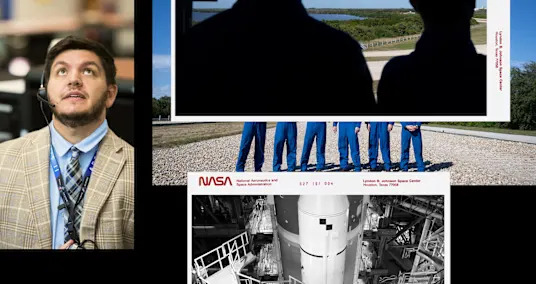
NASA’s efforts to return to the moon have been decades in the making — a process the agency has documented in images at every stage.

The Artemis program was born out of a directive that President Donald Trump signed in 2017, during his first term. It tasked NASA with focusing on “the return of humans to the Moon for long-term exploration and utilization, followed by human missions to Mars and other destinations.”
In a speech in 2019, Vice President Mike Pence directed NASA to put bootprints on the moon again by 2024.
That landing, however, is now delayed until at least 2028.
But NASA began development of the technology being used for the Artemis missions far earlier. Work on the Orion spacecraft that will carry the Artemis II astronauts, for instance, began in 2006. And Congress in 2010 authorized NASA’s Space Launch System rocket, designed to be more powerful than the Saturn V booster used in the Apollo program of the 1960s and 1970s.


Development of the rocket and spacecraft fell years behind schedule, and the Artemis program has been plagued with major budget overruns.
But at long last, NASA aims to launch the Artemis II mission at 6:24 p.m. ET on Wednesday.


The Space Launch System rocket is on the launchpad at the Kennedy Space Center in Florida, following a painstakingly slow, 4-mile rollout from its hangar on March 20 involving a huge moving platform known as a crawler-transporter. It was the second such journey for the rocket, which was first rolled to the launchpad in January, then transported back for repairs to address hydrogen leaks and a blockage in the flow of helium.
The Space Launch System stands at a towering 322 feet tall when fully stacked with the Orion capsule. That makes it taller than the Statue of Liberty though smaller than the 365-foot-tall Saturn V rocket that took the Apollo program astronauts to the moon.
The rocket was designed to reuse components from NASA’s retired space shuttle program. The space shuttle main engines were upgraded into the Space Launch System’s RS-25 core stage engines, and the rocket was built in large part by longtime NASA partners and space shuttle contractors.
The gumdrop-shaped Orion spacecraft can carry up to four passengers. At 16.5 feet wide, it has a habitable volume of around 330 cubic feet. So the crew members have been training to sleep, eat, exercise, use the bathroom and communicate with ground controllers in very tight quarters.
The Orion capsule includes a space toilet (with a door for privacy) that uses a vacuum system to vent urine into space. All other waste is stored for disposal at the end of the mission.
After launch, the astronauts will be able to remove and stow two seats until landing day to give them more room to move. The astronauts will do 30-minute workouts every day, according to the Canadian Space Agency. The capsule has a small device, known as a flywheel, that can be used for squats, deadlifts and other activities.
NASA aims to reuse parts of Orion for the subsequent Artemis III flight, which is slated to launch in mid-2027 and demonstrate key docking and landing technologies in low-Earth orbit. After that, a moon landing is planned for the Artemis IV mission in 2028.
NASA’s Wiseman will command the Artemis II mission, with Glover serving as the pilot. NASA’s Koch and Canada’s Hansen will be mission specialists. The crew arrived at the Kennedy Space Center on Friday ahead of their planned launch.

Wiseman, Glover and Koch are spaceflight veterans. Wiseman spent six months aboard the International Space Station in 2014. Koch spent 328 days there in 2019, when she helped perform NASA’s first all-female spacewalk.


Glover, meanwhile, was on the first operational flight of SpaceX’s Crew Dragon capsule to the space station in 2020.
Hansen is the only member of the Artemis II mission making his spaceflight debut. He will become the first Canadian to venture to the moon.
Artemis II will be just the second outing for the Space Launch System rocket and Orion capsule. The first was the uncrewed Artemis I flight around the moon in 2022.


During that 26-day mission, Orion beamed back photos and videos of the lunar surface, along with dramatic “selfies” showing the spacecraft and the moon with Earth visible in the background. As it circled the moon, the capsule flew over several Apollo landing sites, including the spots where Apollo 12 and Apollo 14 astronauts touched down.


NASA loaded the Orion capsule with mannequins equipped with sensors to gather data about radiation exposure and other conditions of deep-space travel.
After the Artemis I mission concluded with a splashdown in the Pacific Ocean, NASA found unexpected damage to the Orion capsule’s heat shield. That critical layer of thermal protection at the bottom of the spacecraft protects astronauts as they re-enter Earth’s atmosphere.
A NASA investigation found that improper venting in the heat shield’s outer material caused gases to build up. As a result, parts of the material cracked, “causing some charred material to break off.”
To avoid those risks on the Artemis II flight, mission managers will alter the capsule’s re-entry path. The spacecraft is expected to take a steeper angle on its final descent, plowing through the atmosphere faster to minimize the time the heat shield is exposed to the most extreme temperatures.
“If we stick to the new re-entry path that NASA has planned, then this heat shield will be safe to fly,” Wiseman said last year.
This article was originally published on NBCNews.com
LATEST POSTS
- 1
 Incredible Travel Objections for Craftsmanship Darlings to Visit
 - 2The Main 20 Gaming Control center Ever
- 3Believe Should Unwind? Look at These Scaled down Games
- 4Grass Care Administrations for a Wonderful, Sound Yard
- 5Kate Middleton and Prince William unveil annual family Christmas card photo with George, Charlotte and Louis


- ABC News' Sam Champion opens up about recent health scare
- Hamas hands over another body in the Gaza Strip
- Find the Advantages of Careful Eating: Developing a Sound Connection with Food
- It Shouldn’t Be Here: Rescuers Race to Save Whale Stranded in Rare Spot
- Kendall Jenner addresses long-standing rumor about her sexuality
- 5 Instructive Toy Brands for Youngsters
- Careful Living: Embracing the Current Second
- Volkswagen Plant Could Pivot From Building Cars to Supporting Iron Dome Systems
- Doritos and Cheetos dial back the bright orange in new versions without artificial ingredients